
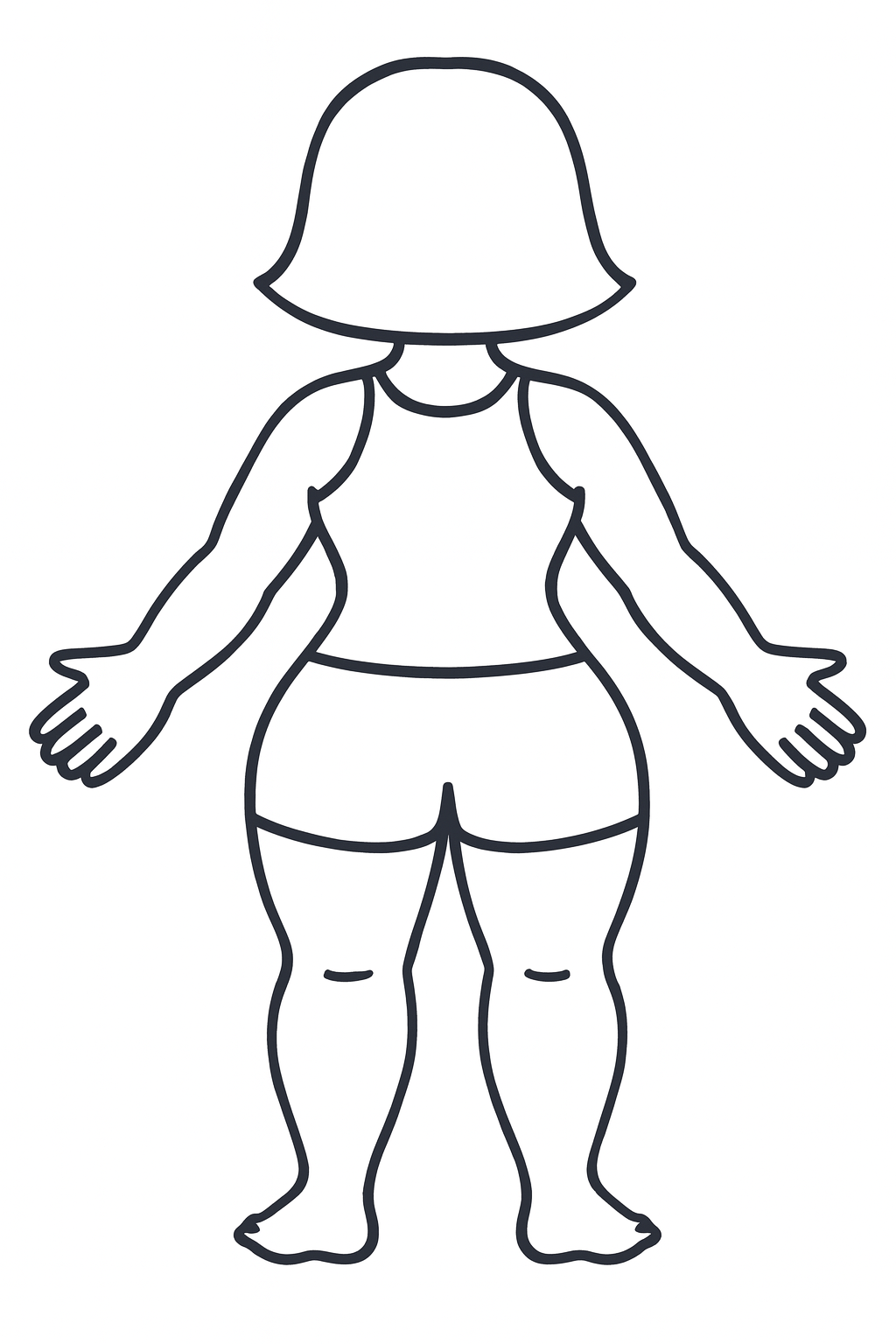
Clinical Lipoedema Assessment
What is Lipoedema?
Lipoedema is a genetic condition that primarily only affects women, due to it being estrogen fed. It is a connective tissue disorder, it is an abnormal and symetrical build up of fatty tissue in the legs, thighs, buttocks and sometimes in the arms. If you have it in your arms, you definitely have it in your legs. This often appears as a disproportinate weight distribution. Some women have ankle and/wrist cuffing. This is because the hands and feet are not affected by it.
This condition causes pain, tenderness, easy bruising while being accompanied by other contributing factors like hypermobility, venous insufficiency and varicose veins.
Lipoedema is very often mistsken for obesity, but it is completly different because the buildup of fat in the limbs do not respond to traditional dieting and exercise in the affected areas. Meaning that when a lady with Lipoedema diets to loose weight she will loose it from everywhere in her body, but in her limbs where its affecting her there is little to no change at all. This is because the fat cells in the affected areas are not normal and do not function properly. Normal fat cells swell and enlarge when there is a surplus of calories (energy) consumed, it is stored here for use at a later stage. When you diet into a calorie deficit those fat cells (surplus energy) has been used and will shrink, this is when you loose weight. The energy attatched to those cells have been used. If it is a lipoedema fat cell, the cell is completly different, it is fibrosed, hardened with jaggered edges. These lipoedema fat cells don’t have an energy source attached to them, hence why when in a calorie deficit they do not shrink and go away. Instead they are storing inflammation in the body. The inflammation is what causes you pain and discomfort. Many women with Lipoedema experience chronic fatigue, sluggishness. We also can have issues with our lymphatic system. This is because the Lipoedema fat cells are so dense and inflammed that it puts pressure on the internal soft tissues in your limbs making it harder for the blood to circulate and the lymph fluid to pass through, this contributes to the heavy, throbbing aches we feel everyday.
Key features of Lipoedema are…
- Fat accumulation: Abnormal accumulation of fat cells, primarily in the lower body, but can also affect the arms.
- Symmetry: Swelling is typically bilateral (both sides are affected).
- Disproportionate appearance: The affected areas are often much larger than the upper body.
- “Cuffed” appearance: The feet and hands are usually not affected, creating a distinct line where the swelling stops.
- Pain and tenderness: The affected areas can be painful, tender to the touch, and bruise easily.
- Poor response to weight loss: While general weight loss may occur, the fatty deposits in the affected areas are often resistant to weight loss efforts.
What do you do if you think you may have Lipoedema?
If you think you have Lipoedema and you havn’t already tried to get a diagnosis from your GP that’s the first place to try. Sometimes you get amazing GP’s who know about this condition or are open to suggestions and to learn, but sadly many women (me included) got miss diagnosed and told to go on yet another diet, to exercise more blah blah blah. to no avail, no referral to the lymphoedema clinic. No help or support, nothing.
If that is you, your other alternative is to go private and seek a diagnosis that way – that is what i had to do, and since my journey of having Lipoedema I trained and worked hard, working my way up the ladder to be able to clinically assess and diagnose women with Lipoedema and supporting you through it.
What help is available for Lipoedema on the NHS?
Sadly there is no surgery offered on the NHS for Lipoedema, but you can get compression garments on prescription every 6 months.
How do you manage Lipoedema in the long term, what options are available?
To manage Lipoedema it is recomended you have a clean anti inflammatory diet. We know it doesnt respond to the usual calorie deficit diets, but studies have shown women have done well on these diets particularly the keto diet. Low carb and high protein diets or heart healthy diets. My advice is to try and see what works for you, what you can stick to. Remember to look after your mental health too.
Exercise it important too, gentle resistance training, none heavy impact sport, like swimming and cycling are very good for you.
Wearing compression garments, these support your delicate tissues, aiding in better lymph and blood circulation, and help manage and control your pain, they can help shape your limbs just giving them some support.
Some ladies have chosen to use GLP-1 injections to help with their Lipoedema symptoms. Some say they have had amazing results from being on them. Again this is something you will have to research and decide if it right for you. There’s not enough clinical assesment studies yet to prove anything either way.
Some women opt to go down the surgical route to remove the Lipoedema fat cells through water assisted liposuction (WAL) water assisted is thought to be the safest and kindest method on your lymphatics. I can’t advise you on what surgeon to go for, but my recomendation is that you do your research and make sure your surgeon specialises in Lipoedema and not just costmetic liposuction. Some women have chosen to go to Germany, Madrid and even Greece for their surgery and others choose to remain in the UK.
Lots of women get Manual lymphatic drainage massage to help, I also swear by Deep oscillation therapy, i find it really helps with the pain in my legs.
Red light therapy and vibration plates have shown to be beneficial aswell. Some women love to do rebounding too,
What ever you choose to do, make sure it’s the right choice for you, I’m here to offer advice where I can. There are lots of Lipoedema support groups on social media and we do have LipoedemaUK as well.
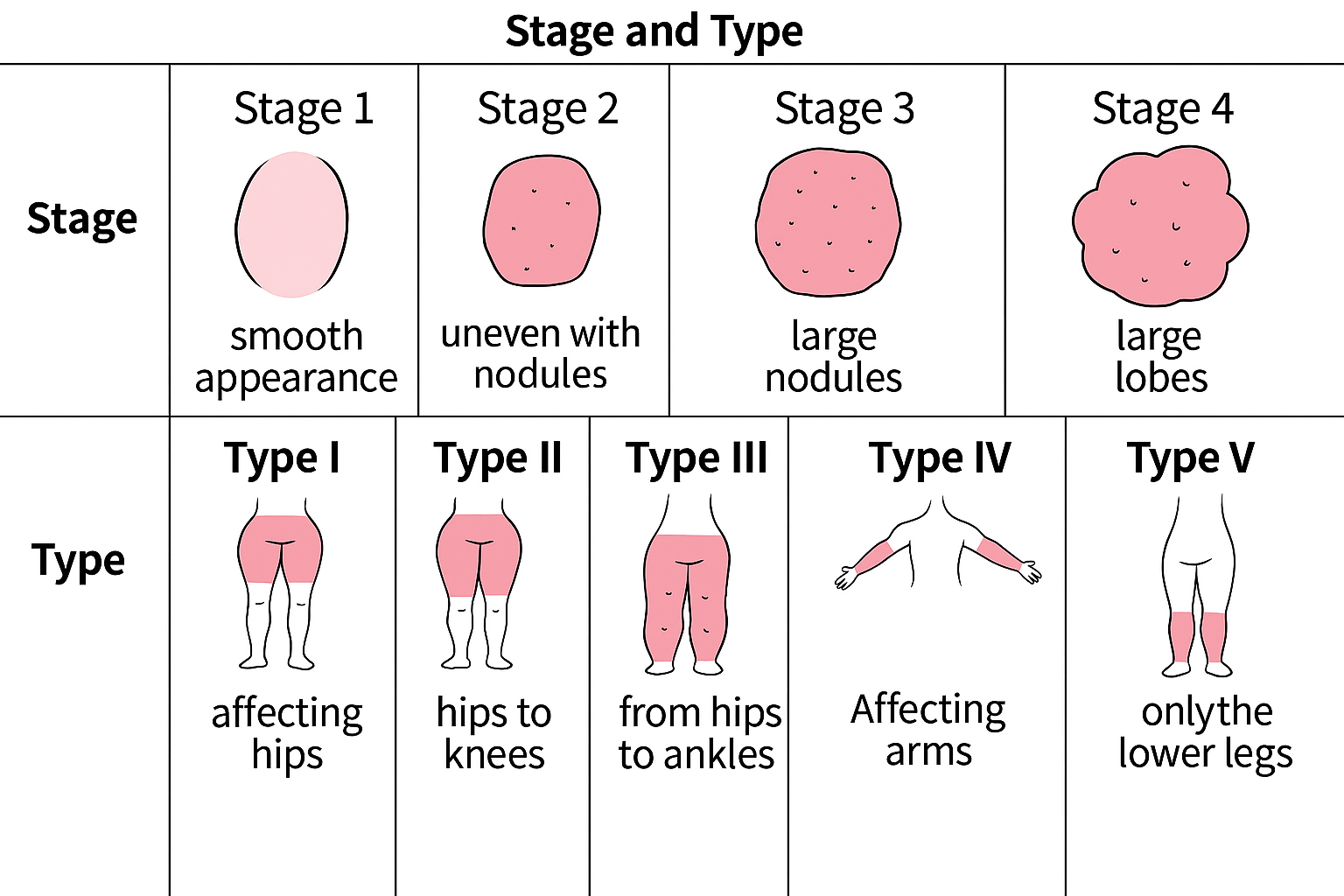
Below you can see the chart that describes the stages and types of Lipoedema
Why am I so passionate about Lipoedema? – Read this and see if my story is similar to yours!
I have always struggled with the disproportionate weight distribution on my body since my teenage years. I just couldn’t understand why my legs were so much bigger then the rest of my body. I ate well, I exercised all the time. I was a keen runner in my teens and 20s. Yet my hips, buttocks and thighs were always so much bigger then the rest of me. I tried everything. I started to have an unhealthy attitudue to food and exercise. I used to weigh everything and track everything down to the very last calorie, which yes you do that when your tracking, but I took it to the extreme of even weighing lettuce! I would only allow myself to leave the gym when my shirt I was wearing was absolutely drenched in sweat, no dry marks left at all. That would indicate to me that i had “worked hard enough”. I even went down the slippery slope of diet pills, popping them like smarties to try and loose the weight off my legs. I have tried every diet going, I was frustrated because NOTHING WORKED! I wondered if I had lipoedem after hearing about it on social media many years ago, but I fobbed it off as, “oh I’m probably just making excuses, I just need to try harder” and I even thought “it’s not me, my legs aren’t bad enough” comparing myself to other Lipoedema images i’d seen on google.
Fast foward to when I had my beautiful daughter in 2015, even though again I ate clean and continued to exercise during pregnancy, I had gained weight, which is perfectly normal in pregnancy for any woman. However for women with lipoedema it can exacerbate it making the symptoms worse. I was still not sure I had it. So I carried on with life as normal being a new mum, I didnt have time to worry about my body with a new born and a single mum. Throughout the following years, I was trying to get back, but I could see the change in my arms and legs and my weight. I put it down to just getting older being in my 30s, this is it, start of the middle age spread as my parents would call it. Until I was on my Lymphoedema training course, We were practicing on each other and I was wearing shorts (which by the way is never, I don’t even own shorts, I had to cut an old pair of leggings to make shorts for the course) and my tutor asked me “what have you got going on with your legs?” I had already been diagnosed with Raynauds disease, venous stasis and venous insufficiency. She replied with “anything else?” she was gently trying to probe me to see if I said I had Lipoedema, but I didnt, so I asked her why? Why was she asking? and that’s when she asked my permisision to give her opinion which I gave. She then told me I had lipoedema. So I went back as a patient and not a student to get myself formally diagnosed as I always struggled and in the past with every issue I had, was due to me “being overweight” according to my GP. Knee pain, well if you were at a healthy weight this will go away, venous issues, again same response, hip pain same response (i actually had surgery on it in the end because I was actully injured but again I was fobbed off)
I found from the clinical assessment that I was actually under weight. This shows how dangerous getting the wrong diagnosis can be. Everything made sense, and looking back on old photos of myself I can now see the earlier signs of it.
Now I continue to eat well, I train lots in the gym, I do what makes me feel happy and get the most satisfaction from which is Lifting weights. I wear compression everyday, focus on being strong to support my body. I will have surgery on my veins in my legs as they are deteriorating and causing pain, and maybe in the future I’ll look at lipoedema removal surgery. It is something to save up for as it’s not cheap and not available on the NHS.
Now I’ve completed my training to be able to clincially assess, diagnose and support women like myself with Lipoedema which I’m very proud of. It took me several years to train to get myself to this level. Building my business, client base while still being there for my daughter.